LMC Update -06 June 2025

Local Matters

Cambs LMC Mental Health Survey

Last call to complete our Mental Health Survey which closes at 12noon on Wednesday 11 June 2025.

https://forms.office.com/e/cazeQWJhC6

If you havent already done so, or are stretched for time, please take a look and just answer those relevant to you.

Anyone wishing to raise a specific concern for us to take forward on their behalf can of course contact us at office@cambslmc.org.  Thank you in advance

Tirzepatide (Mounjaro) for weight management in General Practice 

GPC England has produced a Focus on Tirzepatide (Mounjaro) for weight management in General Practice document, which explains how Tirzepatide is used, commissioning arrangements (responsibility for funding lies with ICBs), and responding to information requests from private providers.

Please see our webpage for links to guidance and template letter.

From your Local IGPM Representative…

Dear fellow Cambridgeshire & Peterborough practice managers

Please find attached the IGPM response to the recent pay proposals impacting General Practice and the concerns raised in terms of the erosion of recent funding uplifts.

If you are not an associate member of the IGPM then you are missing out on an extensive network of support from fellow PMs with a huge wealth of experience, insight, knowledge and resources.

All this could be yours for just £50 a year. More info is available here: https://www.igpm.org.uk/membership

At a time when the NHS is advocating the introduction of formal standards of performance across all NHS management roles, let IGPM represent you in advocating something fit for purpose in General Practice. We have an existing accreditation pathway and representation at the table to ensure the collective voice of PMs is heard as these plans are made.

If you would like to find out more about how the IGPM can support you then please do get in touch. I am here to help as your regional IGPM representative in any way I can.

Kind regards,

Melanie Gearing – Practice Manager, Alconbury & Brampton Surgeries

National BMA Update 

DDRB pay award 2025-2026

The DDRB pay award recommendations for 2025-26 were finally announced, with a 4% uplift to the pay element of the GP contract and the pay range for salaried GPs. The Government has accepted the recommendations in full, but 4% won’t be enough to ‘fix the front door’ of the NHS nor expand GP teams and ‘bring back the family doctor’.

BMA’s new report The Value of a GP informs HM Treasury ahead of the comprehensive spending review why only more investment into general practice will secure the recovery of the wider NHS.

GPC England Chair, Dr Katie Bramall has written to Wes Streeting to seek necessary clarity and to ensure GPs and practices face no financial disadvantage. We need clear funding to ensure the full 4% can be passed onto employed GPs, to meet AfC guidance in ARRS roles, and have also made the case as to why the 4% needs to be applied across all three pay domains to support practice stability.

It is clear there is insufficient investment to allow practices to create additional GP roles.  Mr Streeting was advised  in late July 2024 of GPC England’s view that whilst the GPs in ARRS policy was helpful as a quick fix upon immediate arrival in Government, it won’t deliver on improving continuity of care, nor social equity, nor the evolving problem of emerging GP unemployment.

Mr Streeting has been asked again to look at direct practice reimbursement for additional GP roles. Government needs to act now, ahead of August, and ahead of the new cohort of GPs qualifying in this country, many of whom will be preparing for under-employment, and unemployment. We have a moral and ethical duty to them, and the taxpayer, to keep them in our NHS practices, providing care to patients. GPs without jobs = patients without care.

GP Wellbeing Resources

After the shock and upset of the Bank Holiday events in Liverpool, thoughts turn to our GP colleagues providing help and support to affected communities. So often BMA is the first port of call for societal stress, and that can take its toll. That week also saw the tragic news of the loss of life of Chorley GP, Zak Uddin. Thoughts are with his family, practice and patients.

Please remember you have the support of your colleagues, LMC and the BMA. A range of wellbeing and support services are available to doctors, and anybody who is feeling under strain is encouraged to seek support. Please take a moment to check in on your colleagues’ wellbeing and look out for each other.

Support comes in various forms, from the BMA’s counselling and peer support services, NHS practitioner health service and non-medical support services such as Samaritans. The organisation Doctors in Distress also provides mental health support for health workers in the UK.  Also take a look at a poster with 10 top tips to help support the wellbeing of you and your colleagues.

The Cameron Fund supports GPs and their families in times of financial need, whether through ill-health, disability, bereavement, relationship breakdown or loss of employment. The RCGP also has information on GP wellbeing support.

Please visit the BMA’s wellbeing support services page or call 0330 123 1245 for wellbeing support.

GP Unemployment Campaign

The BMA’s Sessional GPs Committee and GP Registrars Committee launched a major campaign to expose the worsening crisis of GP under and unemployment. In a joint letter to the Secretary of State, the committees issued an urgent call for action, warning that up to a thousand GP registrars finishing training this August could be left without jobs, despite patients facing severe delays in care and practising GPs struggling under unsafe, unsustainable workloads. This unacceptable situation is backed by our survey: 15% of GPs couldn’t find any suitable work, 56% are seeking more NHS hours without success, and 21% are planning to leave the profession altogether.

The letter demands immediate Government intervention, including ring fenced, direct to practice core funding separate from the failing ARRS scheme, to employ newly qualified and underemployed GPs in roles that deliver continuity of care. Read more about the GP un/underemployment campaign.

New drive to find undiagnosed infected blood patients

All new patients registering at GP practices are to be asked if they had a blood transfusion before 1996, as part of an NHS drive to find undiagnosed patients affected by the contaminated blood scandal.  Each year, around 400,000 people born before 1996 – around half of new sign-ups online – will now be asked if they received a historic blood transfusion, with those who did then being offered a test for hepatitis C.

Patients will be able to order discreet, self-testing hepatitis C kits to complete at home, involving an easy finger prick blood sample which is then posted to a lab for analysis – or they can also access testing at GP surgeries, sexual health clinics and other services.

Seniority payments update

Seniority payments were historically made to GP partners based on their length of NHS service and income received. The Scheme closed to new members on 1 April 2014 and was then phased out over a six-year period to March 2020.  These annually released sums were diverted into the Global Sum.

Seniority payments were based on thirds of average partner income, with no payment being made if a partner drew under a third of average income, 60% between one-third and two-thirds, and those receiving over two thirds average income receiving a full payment. The actual entitlement depended on the publication of each year’s Final Seniority Factor (FSF), which was last published in April 2020.

After many months of discussions, BMA has now finally received assurances from PCSE that they will not seek to undertake a reconciliation exercise for the financial years 2013/14, 2014/15 or 2015/16. However, a very small number of practices may receive further communications in future about the Tranche 1 years (2017/18, 2018/19, and 2019/20). Further information is available here.

Removal from Performer’s List: Urgent, 111 and Out of Hours GPs

BMA has been alerted to several areas where GPs exclusively working in OOH, 111 and urgent care have been informed that that they will need to be removed from the Primary Medical Performers’ List. They have been advised to resign from the performers list, or risk a formal removal process.

Concerns have been raised centrally with NHSE as this risks unnecessarily removing a cohort of GPs that are delivering primary medical services, which could impact upon their ability to undertake practice work in the future.

If you have been affected by this, BMA would be keen to hear from you, if you are a BMA member, please contact via the member services Contact us and our GPC email: info.gpc@bma.org.uk

Foresight AI model trained on GP data

Following reports in the press that GP Data extracted via GPES under a repurposed COVID-19 extract formed part of a wider set of data that had been used to train an AI model without knowledge or approval of an advisory group set up to oversee it, BMA and RCGP wrote to NHS England via the Joint GP IT Committee.

In its letter, BMA  outlined the seriousness of this action and sought immediate clarity on how the data sharing took place. This is an ongoing situation, and further updates are expected in the next BMA update.

LMC Update – 02 May 2025

National Updates from BMA

GP Contract webinars and guidance 

Last month the GPC England officer team delivered a series of webinars outlining the changes and funding to the 2025/26 GP contract. Thousands of you joined the presentation and question and answer sessions. If you missed out, you can still catch up by watching the webinar recording and view the slide deck here.

BMA continues to update the guidance on the 2025/26 contract changes.

Advice and Guidance Enhanced Service

As part of the new GMS contract for 2025/26, an Enhanced Service specification for Advice and Guidance (A&G) will provide a £20 Item of Service fee (IoS) per ‘pre-referral’ A&G request. Please keep an eye out for BMA’s imminent guidance.

Rejecting unnecessary proformas and forms

Read also guidance on rejecting unnecessary proformas and forms, which create additional workload, delayed patient care, and unnecessary bureaucracy for GP practices – when a relevant, factual referral letter would suffice. Read guidance.

Although the national dispute with Government is over, the importance of local bargaining, collaboration and agreement to resolve ongoing commissioning gaps continues through our ‘Mind the Gap’ campaign. Read the latest updates here

Please also continue to refer to safe working guidance, which includes template letters which help practices manage workload and limit capacity to deliver safe, high-quality care.

AI in General Practice 

Following a busy week which saw a series of announcements generate a renewed focus on the role of AI in general practice, GPC has developed this brief note ahead of more substantial guidance aimed at supporting practices to meet their regulatory obligations. BMA will be sharing a more detailed document in time.

GP Connect and e-consult contract changes

Following the agreement of the 2025/26 GMS contract, a new requirement will come into place in October 2025 mandating practices to provide some external parties with the ability to submit information to the GP record and, in some limited cases, access information within the record. While much of the detail of this requirement is still to be determined, BMA has produced an FAQs document to speak to some of the more pressing questions heard from members

Similarly, the scope of e-consult platforms is expected to expand as patients will have a wider range of ways to access and engage with GP services. Please see an FAQs on that change here.

OpenSAFELY

You may have seen an email this week from NHS England to all practice managers and GP partners/contractors about the expansion of the OpenSAFELY secure data service. GPC England has long advocated for using OpenSAFELY more widely, and BMA is aware that the plan is to now cautiously expand to cover non-COVID analyses.

The Joint GP IT Committee with input from the BMA and RCGP supports OpenSAFELY, as the team led by Professor Ben Goldacre have managed to develop robust methods for privacy and transparency which protect GPs as data controllers for the GP record:

Users don’t need to interact directly with pseudonymised patient records to run their analyses. All actions in the platform are publicly logged, in real time with the pseudonymised data remaining within the electronic health record system your practice uses, and the practice continues to be the data controller. Analyses run remotely through the OpenSAFELY platform, with NHS England acting as data controller for the service, once the initial queries of the pseudonymised data have occurred. Only aggregate information will leave the platform.

There will be a follow-up email from NHS England about the Direction in a couple of weeks, which is the point when you will be asked to press a button to acknowledge receipt and BMA will communicate more with you at this stage around the next steps which will need to be taken.

Shared care prescribing principles

BMA has now published Shared care prescribing principles. Shared care prescribing refers to medication which is initiated by a specialist and ongoing prescribing and monitoring is shared with a GP practice, usually accompanied by guidance or a shared care agreement. The principles that apply to shared care prescribing are:

  • It is a non-core voluntary activity that can be declined by the GP practice for any reason
  • The practice is satisfied with the quality assurance and clinical governance of the specialist provider
  • If any ongoing medication monitoring is required, responsibility for this should be clear within associated guidance in the form of a shared care agreement
  • The appropriate stabilisation period has occurred before prescribing is handed over to the GP
  • There is enduring specialist input
  • Any additional work undertaken by general practice in the form of medication monitoring, is delivered through a funded, commissioned pathway

Read the full guidance: Prescribing in general practice

Structure of GPCs and how they interact with LMCs

BMA has published a video explaining the structures of the BMA’s GP Committees (GPCs) and how they interact with LMCs.

Find out more information about the GPCs: BMA general practitioners committee UK overview

Maximise your chances or job success

3 June 2025

Join the virtual workshop designed to help you navigate the GP job market with confidence. The interactive event is designed to support ST3 GP registrars, sessional GPs seeking new or additional roles or hours, GPs qualified outside the UK looking for their first NHS roles, GPs returning to practice after a career break, and First5 GPs. Discover the support and resources available from the BMA and other organisations to aid your job search. Register to attend here

GPC England regional elections 2025 results

The elections for the regional seats on GPCE which were up for election have now concluded. The below candidates have been elected for three-year terms starting from June 2025 to June 2028.

Cambridgeshire/Bedfordshire Dr Diana Hunter
Hertfordshire Dr Violaine Carpenter
North & South Essex Dr James Booth
Barking & Havering/Redbridge & Waltham Forest/City & E London Dr Asad Ashraf
Cumbria & Lancashire Dr Preeti Shukla
Wigan & Bolton/Bury & Rochdale/W Pennine Dr Alan Dow
South & West Devon/Cornwall & Isles of Scilly Dr Bruce Hughes
Hampshire & Isle of Wight Dr Matthew Prendergast
Kent Dr Gaurav Gupta
Surrey & Croydon Dr Julius Parker
East Yorkshire / North Lincolnshire / Lincolnshire Dr Reid Baker
Calderdale/Kirklees/Leeds/Wakefield Dr Ansar Hayat

LMC Update – 08 April 2025

Local Matters

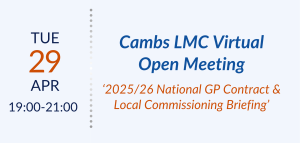
Cambs LMC Virtual Open Meeting – Tue 29 April 2025

Cambs LMC will be hosting a virtual Open Meeting on Tuesday 29 April at 7pm, delivering a briefing on the ‘2025/26 National GP Contract & Local Commissioning Briefing’. A next steps discussion focusing on:

  • What’s new?
  • 2025/26 GP Contract
  • 2025/26 Local Commissioning Arrangements
  • Next Steps
  • Questions

Register here

Local Commissioning Agreement

The ICB Local Commissioning Agreement has been sent out with an extended sign-up deadline of 30 April 2025. Thank you to practices who have already sent in questions in to us. In light of the changes to the agreement which now pays for more services on a tariff basis we would encourage practices to use this time to review the funding offer against their practice populations and cost of providing the services. Please send any further questions or queries to office@cambslmc.org and we will collate responses and provide feedback over the next couple of weeks and at the Open Meeting.

National BMA Update 

Local action: Stay safe, stay organised, stay united

GPC England’s national dispute with Government may be over, following the acceptance of the 2025/26 contract, but the importance of local action to resolve ongoing commissioning gaps continues. Read the BMA’s latest local action guidance on their GP campaign page.

The BMA continue to strongly advocate for safe working and encourage practices to identify unfunded and underfunded work in their areas and to engage in local action to address commissioning gaps. When locally commissioned pathways fail or there are service gaps, practices should initiate re/negotiations, via their elected LMC representatives, with ICBs to secure appropriate resourcing.

Practices who are undertaking under/unfunded work should either be fully resourced, to ensure patient care – for some of the most vulnerable people in society – is sustainable, or, with the support of their LMC, consider serving notice to ICBs. LMCs are integral to facilitating fair and effective local agreements between practices and commissioners – supported by BMA national advice and resources. This is simply business as usual local action, coordinated by your LMCs, which has been happening for many years.

The BMA safe working guidance continues to be GPC England policy and is regularly updated. New planned 2025/26 contractual asks, such as patient access to e-consultations for routine care as well as requesting fit notes or medication queries, does not mean GP practices must offer unlimited capacity that jeopardises patient or staff safety.  The safe working guidance includes template letters which help practices manage workload and limit capacity to deliver safe, high-quality care.

All colleagues are encourage to read GPC England’s guidance on the 2025/26 contract changes, where further additional related guidance will be added in the coming days and weeks.

GP Contract Webinars 2025

All colleagues are invited to join the BMA to hear the GPC England Officer team discuss the detail of the changes in the GP Contract and its funding for 2025/26. After the presentation there will be time for questions and answers.

  • Wednesday 9 April           19:00-21:00                        Register here
  • Thursday 10 April             12:00-14:00                        Register here
  • Wednesday 23 April        19:00-21:00                        Register here
  • Thursday 24 April             12:30-14:30                        Register here

Read more about the contract changes, BMA advice and the webinars: GP contract 2025/26 changes

National Insurance Contributions Bill

The Government has continued to reject Lords amendments to the National Insurance Contributions (Secondary Class 1 Contributions) Bill which would potentially exempt GPs from ENICs (Employers National Insurance Contributions) increases. They have used the reason that the Lords Amendment ‘interferes with the public revenue’ which is inappropriate as the elected chamber The Commons has final say on tax and financial issues (a position dating from the Parliament Act 1911) and has used its majority to push the Bill through. The Bill will now receive Royal Assent, becoming law on 3 April 2025.

Over half of GPs in England have missing years of pensions data

BMA’s recent Freedom of Information request has revealed that 56% of GPs in England have missing pensions records up to 2022/23, with 156,896 years of pension data missing in total. This matters because without your pension record being up to date you cannot determine potential tax charges and whether you can increase work without penalty, nor make informed decisions about your pension savings. This is also important for those affected by the McCloud remedy. The BMA have highlighted Capita’s failures in the media and calling for an urgent solution to this significant issue.

The BMA continue to meet with Capita, NHS BSA and NHSE to put pressure on them, and although we had verbal commitment that they will write to affected members with specific personalised information in relation to missing years in pension records, no timeline was provided. Whilst the BMA firmly believe this is a problem that Capita, NHS BSA and NHSE need to work together to resolve, you can also take action to make sure your record is up to date and encourage you to do so and the BMA have produced step-by-step guidance to help you.

GP pressures

The Sessional GP Committee (SGPC) has opened voting for 16 elected members of the committee. Election counting rules will be applied to ensure that a candidate will be elected from each of the committee’s thirteen regions. The committee’s regions are based on the BMA’s ten English regional councils, in addition to one representative in each of Scotland, Wales and Northern Ireland.

Voting will close at 12pm on Monday 14th April 2025. For more information on these elections, please visit the BMA Sessional GP Committee webpage.

Rotational training survey

The BMA, as part of the pay offer to English Resident Doctors, has agreed to undertake a review into rotational training with the UK Government. Additionally, the BMA is in discussions regarding reforms of rotational training in Scotland, Wales and Northern Ireland that are separate to this review. Rotational training is the current form of training whereby resident doctors ‘rotate’ between trusts/health boards and, in many cases, employers across their training programme.

In order to ensure the BMA can achieve the best possible reforms to the system, we are asking GPs who are educational clinical supervisors to respond to some questions about the role. The survey asks about the rotational training system from your view as an educational clinical supervisor for rotating doctors, which will inform how the BMA can deliver substantive, useful changes. Take the survey here.

GP focus group – primary care provision for refugees and asylum seekers project

As part of a project to improve the provision of primary healthcare to people seeking asylum and refugees, the BMA’s International team will be holding a focus group online on 4 June 2025, 14:30-16:30. Input from the group will help lobby the government to better support doctors in providing high-quality healthcare, and inform updates to the BMA’s Refugee and Asylum Seeker Patient Health Toolkit.

If you would like to attend the focus group or find out more, contact info.international@bma.org.uk.